
Most innovative companies celebrate too early. They mistake initial traction for inevitable success, only to discover they’ve wandered into what Geoffrey Moore famously called “The Chasm”. A marketing pitfall where promising ventures often sleepwalk into and ultimately fail to escape.
I’ve recently witnessed this phenomenon: a European hardware company in the male aesthetics market that had raised millions during, achieved significant sales growth, and launched a spectacular crowdfunding campaign was seeking brand strategy support.
Their history projected remarkable growth ahead. Yet their sales had been declining for months, leaving them with unsold inventory and a shattered marketing team.
Their story offers good learning for marketers of innovative technologies. But first, a little marketing theory.
The Chasm: where innovation goes to die
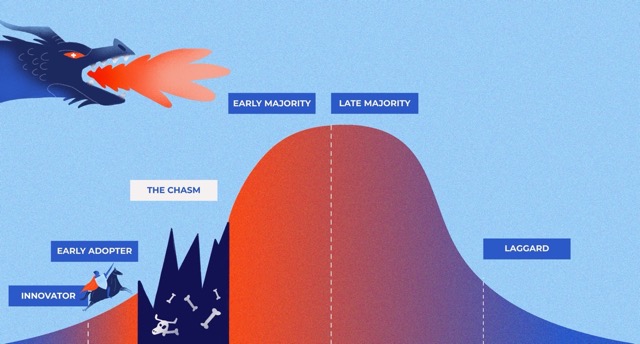
The technology adoption lifecycle and “The Chasm” — Geoffrey Moore’s model highlights the critical gap between Early Adopters and the Early Majority, which many innovative companies struggle to cross.
The Chasm (or The Adoption Gap) framework (first observed by Warren Schirtzinger and Lee James at Regis McKenna, introduced to the world by Mr Moore) reveals that early adopters and mainstream customers are fundamentally different and there isn’t a smooth transition between them as Everett Rogers’ famous technology adoption curve implies.
Early adopters, the ‘visionaries’ and technology enthusiasts are a relatively small and homogenous group, who buy products for entirely different reasons than the early majority. They often buy what helps them self-actualise as mavericks. Shiny new tech attracts them.

On the other hand, the early mainstream market is a constellation of people with often extremely heterogeneous needs, with buying motives and barriers that are hidden from marketers’ eyes. Especially from eyes that are still blurry from the hangover of their big success on the early market. They don’t anticipate that their most significant burden is yet to come.
This creates a treacherous gap that most companies fail to navigate.
The early market thrives on innovation and potential. This is an oversimplification, but in general, it is true that these customers are willing to tolerate bugs, incomplete features, and steep learning curves because they’re excited by the technology itself. They see themselves as pioneers, gaining a competitive advantage from being first to market with cutting-edge solutions.
The mainstream market are the majority. Pragmatists who seek complete, reliable solutions. They want references, proven track records, and assurance that you’ll be around tomorrow. Most critically, they need to see how your innovation solves a pressing problem better than existing alternatives, not just differently. And again, they aren’t just one segment, but many.
The generally higher-risk your industry is, the more people or money involved in the decision-making, or the bigger the reputational damage a wrong buying decision causes, the bigger this chunk of the curve will be.
The male aesthetics example: trust in a scam-ridden market
The challenge becomes particularly acute in industries plagued by fraudulent players. Consider the male aesthetics and hair loss market where the hero of our story had embarked on a journey. This is a sector so rife with fraud that the American Hair Loss Association estimates 99% of marketed hair loss products are completely ineffective, creating deep customer scepticism toward any new entrant.
Customers have been burned by countless “miraculous” promises, “guaranteed results,” and celebrity endorsements for products that simply don’t work.
For genuine breakthrough companies in such markets, crossing the chasm requires more than product excellence and clinical trial evidence – it demands rebuilding trust from the ground up. The early majority in scam-prone sectors are not just pragmatic. They’re actively suspicious. They’ve learned to distrust before-and-after photos, testimonials, and even clinical studies.
Focus on beachhead markets
The solution lies in what Moore calls the “D-Day strategy” – concentrating resources on a narrow beachhead market before attempting broader expansion. Instead of trying to appeal to everyone suffering from hair loss, a successful strategy for our hero was to identify a specific subsegment where they can dominate completely.
During our conversations about this specific medical hardware company, TRAFIK’s strategy consultant, Professor Brian Smith called for a Domino Strategy (also known as a bowling pin strategy), in which marketers, once they have conquered the initial niche market, can jump into adjacent segments, using their success as rocket fuel to travel further.
For companies in scam-ridden sectors, finding the right first post-Chasm market becomes even more critical. Success requires finding that initial segment of educated, sceptical customers who will do the deep research necessary to separate legitimate innovation from marketing hype. These customers can become powerful validators for the broader market if their trust is won with genuine results and transparent communication.
What will you need to successfully cross your chasm?

Based on our experience, marketers navigating the transition need three pieces of knowledge to significantly improve their chances.
1. A binocular: to get a clear, in-depth sight of what is over there
Whether you compete with snake oil merchants or in more legitimate categories, trust is paramount. Early majority customers will trust you if you have a genuine answer for their multi-layered needs.
Can you see their functional needs clearly? Our hardware company could. They understood that people were looking for a proven solution that could fit into their daily routine without much disruption. And probably you can too. You wouldn’t have gotten this far if you couldn’t. But sorry, that alone won’t be enough.
Can you also see what drives them on a social and emotional level? That is something, because often even the customers themselves struggle to name it.
But to really cross the chasm, you need to look closer still. Invest in research that gets at your future customers’ self-actualisation needs. In other words, understand how they see their truest and best selves. That is what gives you the sight lines to build a value proposition they cannot say no to.
Have some time for further learning? Ask your favourite AI engine to explain Kurt Goldstein, Carl Rogers, and Abraham Maslow’s work in this field. Understanding self-actualisation was one of those rare “Aha!” moments for me. Maybe it will shape your thinking as well.
2.) A net: to catch your new targets
Once you have defined the value proposition that helps your target customers feel right about choosing you, the job is to make sure they hear it, remember it, and carry it with them to wherever buying decisions actually happen.
That starts, again, with understanding your customers more deeply. Not just who they are, but where they roam. From what sources do they get information about solutions like yours? How do they weigh those sources against each other? And who else has a hand on the rope? Key opinion leaders, trusted peers, specialists they defer to, or as our male aesthetics company discovered, the life-partners who often have the final say.
A net only works if you place it on the right path. You need a plan that meets your customers step-by-step as they move through their decision, answers their basic needs early, earns a place on their shortlist, and then speaks to the deeper needs that get you the win.
It sounds straightforward. It rarely is.
Old nets catch nothing in new terrain. In the aesthetics market, before-and-after images and Trustpilot reviews were once reliable tools for winning trust. Now, when convincing images can be generated in seconds and review platforms are flooded with bots, those same assets can do the opposite of what they were designed for. Putting them on your shopfront no longer signals credibility. For a sceptical buyer, it can signal exactly the kind of operator they were hoping to avoid.
3.) Your coat of arms: to signal trust and value at every touchpoint
In the early market, you can get away with a loose, half-formed brand. Visionaries buy the story, the founder, and the promise of the technology. But in the early majority, your brand becomes the crest people read before they decide whether to lower the drawbridge.
A coat of arms is not decoration. It is a disciplined, consistent system of symbols that communicates allegiance, credibility, and permanence at a glance, before a single word is exchanged. Your brand works the same way. It is not a new logo or a nicer website. It is the disciplined translation of your beachhead insight and value proposition into clear promises, proof, and behaviours that hold their shape over time.
It needs to answer three silent questions that every sceptical buyer carries, whether they are shopping in a scam-ridden category or making a decision where their career and reputation are on the line: “Can I trust you?”, “Are you for people like me?”, and “Will you still be here when it matters?”
Your coat of arms earns the right to answer those questions if it is built on three things. A specific promise rooted in what your target customers are trying to become, not a list of product features. Proof that holds up in a low-trust world: clinical or technical evidence translated into plain language, conservative claims, honest limitations, and real usage stories that do not feel staged. And a set of distinctive, recognisable codes, visuals, tone of voice, rituals, and experiences, that make you easy to spot and remember when real buying moments arrive.
Done well, your brand travels without you. It carries your value proposition into rooms you have not entered, compresses everything you have learned about your niche into a single intuitive signal, and gives the right people a reason to say “yes, this feels right” before you have had the chance to make your case.
That is how you climb out of the graveyard and onto the mainstream side of the chasm.
The stakes couldn’t be higher.
The companies that successfully cross the chasm don’t just survive – they have the chance to become market leaders, set a standard, define entire categories and last but not least, make their shareholders rich. Those that fail join the vast graveyard of innovations that never reached their potential, despite having superior technology and adequate funding.
The European company I mentioned earlier recognised they were in the chasm, which puts them ahead of many competitors who mistake declining growth for temporary market conditions. With strategic focus on a specific beachhead market and systematic trust-building in their scam-ridden industry, they still have the opportunity to join the ranks of companies that successfully made the leap from early success to mainstream dominance.

The chasm isn’t insurmountable, but it is unforgiving. Companies that acknowledge its existence and adapt their marketing strategy accordingly can emerge stronger. Those that don’t may find that their initial success was just an expensive detour on the road to irrelevance.